The eye is numbed with drops — the procedure involves little pain and is a relaxed experience.
Multifocal premium lenses
MIOL — refractive lens exchange.
The natural lens is replaced with a high-quality, multifocal premium lens — sharp vision up close, at intermediate distance and far away. From your mid-40s, often the most lasting option.
“It was painless and really easy. Everyone was very friendly to me and I felt very comfortable.”
Queri · Google review (translated)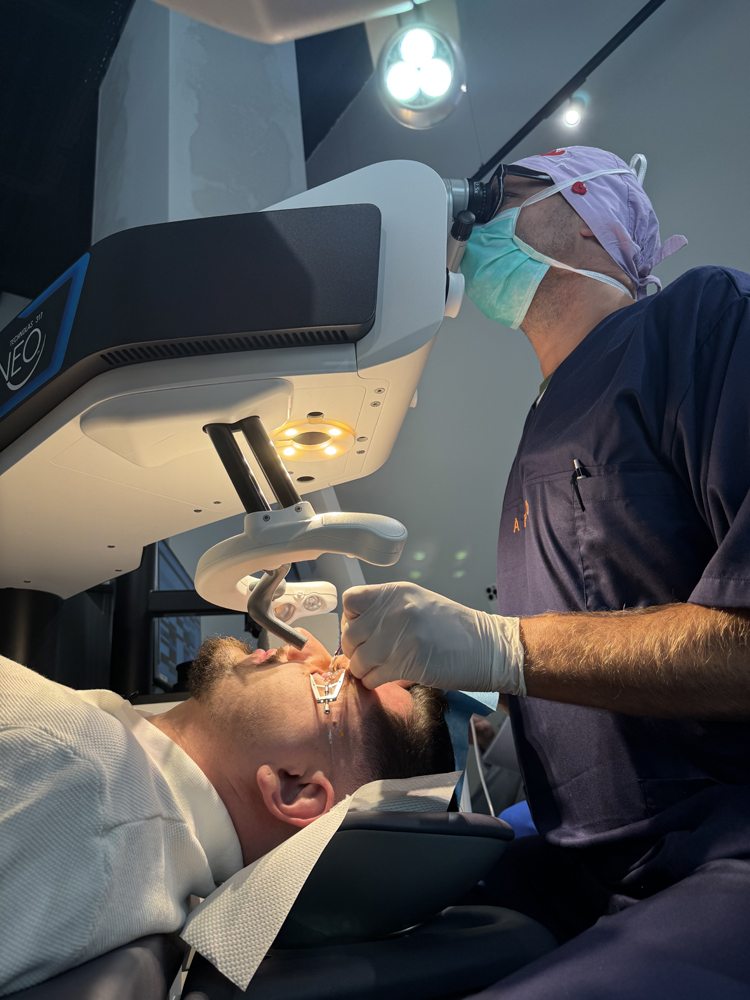
At a glance
- Sharp at every distance — near, intermediate, far
- Little pain thanks to anaesthetic eye drops, quick healing
- A cataract will no longer develop in future
- A widely proven standard procedure
How the procedure works
The natural lens is gently removed and replaced with the multifocal premium lens.
Vision usually improves after only a short time and stabilises over a few weeks.
Cost of lens exchange
CHF 8,500 Fixed price for both eyes
If you have a cataract, health insurance covers the surgical portion — you only pay the surcharge for the premium lens.
Book your free pre-assessment (opens in a new tab)- Comprehensive pre-assessment
- MIOL surgery on both eyes
- All eye drops
- All follow-up checks
- Re-treatments within 10 years
No hidden costs — transparent prices.
The alternative without lens exchange
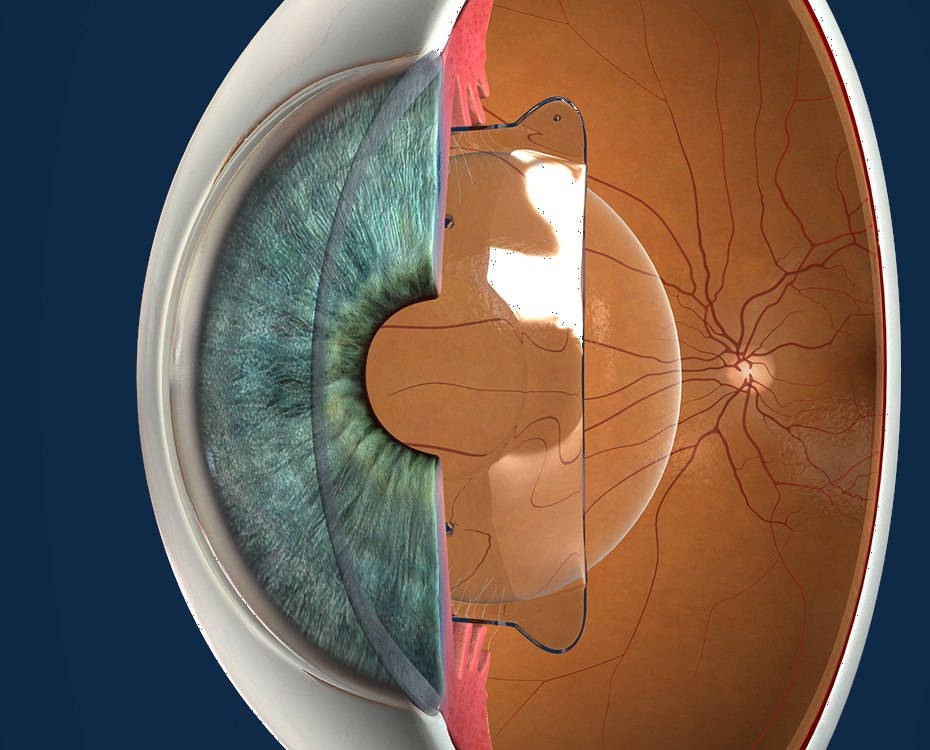
Younger, with a high prescription? The ICL.
If you do not yet have presbyopia, the implantable contact lens is often the better choice: it complements the natural lens instead of replacing it — and is reversible.
ICL – Implantable contact lensFrequently asked questions
Who is a lens exchange suitable for?
Usually from your mid-40s, when presbyopia sets in or reading glasses become a constant companion. The free pre-assessment will show whether it is right for you.
What is a multifocal lens?
An artificial lens with several focal points: it focuses light so that you can see sharply up close, at intermediate distance and far away.
Can a cataract still develop later on?
As a rule, no. A cataract is a clouding of the natural lens — once it has been replaced with the artificial lens, a cataract can no longer form on that lens.
Does health insurance cover the costs?
If you already have a cataract, health insurance usually covers the surgical portion — you pay the surcharge for the premium lens. Without a cataract, it is a private medical service at a fixed price.